Decentralized energy generation structures and digitalized grids generally increase efficiency, sustainability, and resilience. At the same time, the evolving resilience profile also creates new attack surfaces and shifts systemic dependencies, away from primary energy sources and toward specialized raw materials, electronic components, and service providers. Safeguarding critical energy infrastructure has therefore become a strategic necessity considering the energy transition, rising cyberattacks, hybrid threats, and rapid developments in artificial intelligence and satellite technology. Against this backdrop, the multinational demonstration project COPERNOS (Common Operational Picture for Energy System Resilience via Multi-Layer-Network Observation and Enhanced Situational Awareness) is being launched as part of a NATO initiative. Its objective is to establish a civil-military common operational picture (COP) capable of identifying, assessing, and classifying threats, disruptions, and anomalies along critical energy infrastructures at an early stage, thereby enabling a coordinated response chain.

Integration of Operational Technologies
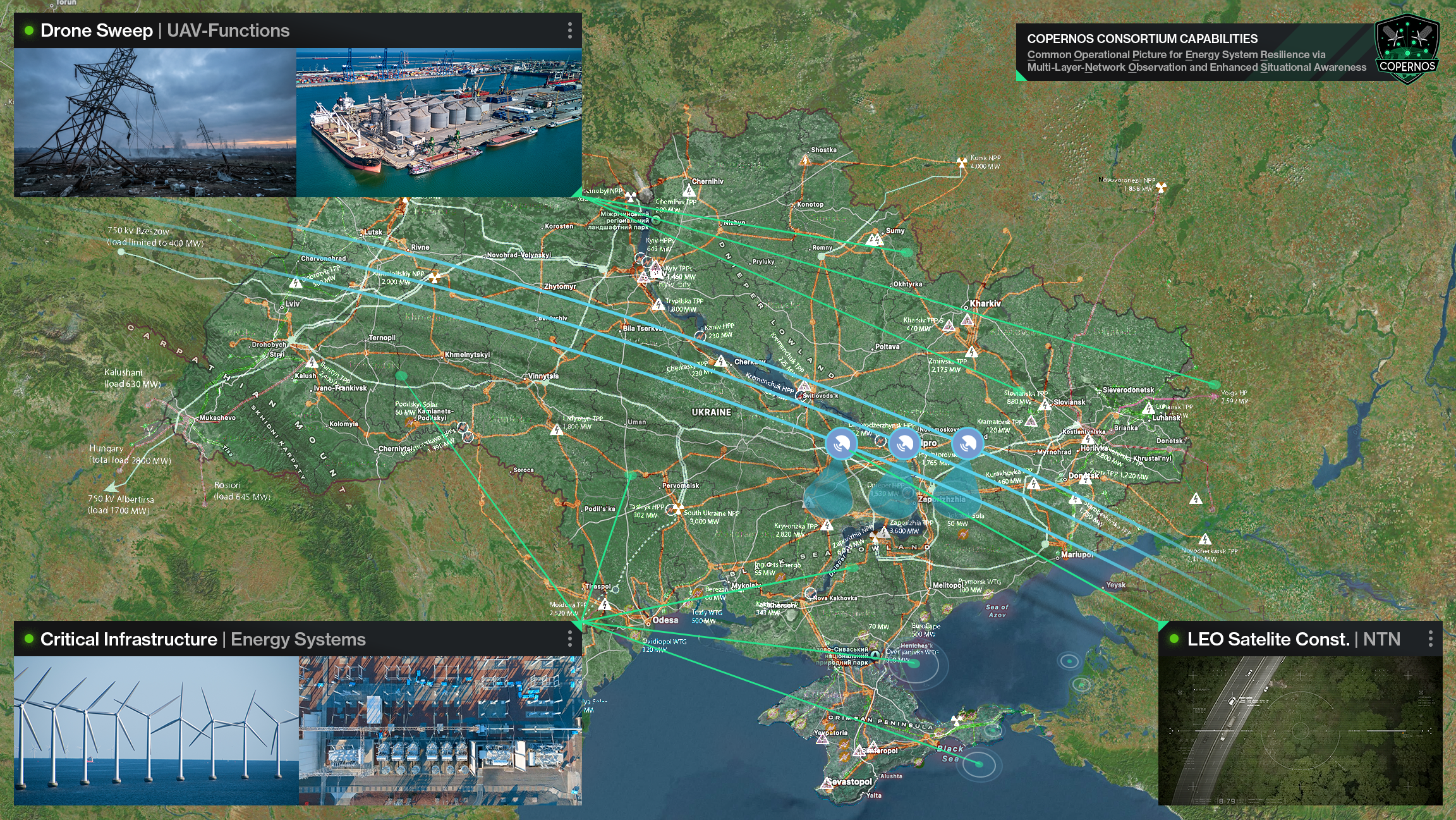
COPERNOS deliberately begins by intelligently interconnecting already available and proven technologies: Satellite-based communication and sensor systems, operational drone platforms, sensors integrated into energy facilities, and AI-based analytical methods will be gradually combined into a multi-layered overall architecture through continuous development.
The project thus follows a pragmatic approach: within 18 months, a demonstration environment will be available that realistically represents key functionalities. These include:
- secure transmission of sensor data via combined terrestrial and satellite-based networks,
- AI-assisted anomaly detection and prioritization according to the triage principle,
- a shared operational picture available almost in real time to enable faster and more informed decision-making.
Components already in operational use, such as small satellites in Low Earth Orbit (LEO), communication modules mounted on drone platforms, or AI-based analytics software, will be systematically integrated, further developed, and, where necessary, synergistically networked with additional systems. COPERNOS thereby accelerates the transition from existing standalone solutions to a coherent overall system.
From Sensor Data Streams to Actionable Decisions
In an operational scenario, COPERNOS links different data sources: if grid sensors register unusual voltage or frequency deviations, these signals are automatically correlated with environmental and imagery data obtained from satellite or drone reconnaissance. If simultaneous activities are detected near sensitive infrastructure, such as offshore facilities or cable routes, the system generates a prioritized alert with an evaluation indicator. The redundant combination of terrestrial and space-based communications ensures that information flows remain intact even if individual networks fail or are disrupted. Instead of isolated reports, a consolidated operational picture emerges quickly, providing a clear basis for decision-making. Distributed AI models analyze data streams close to the source (edge processing), reducing response times.
Dual-Use Value for NATO Partner Nations and Energy Operators
COPERNOS is designed as a dual-use project. Civilian operators benefit from reliable early-warning information, improved incident coordination, and a sound basis for predictive maintenance and restart strategies, for example in the event of large-scale power outages. Armed forces gain an interoperable operational picture that helps ensure command and operational capability within the civilian energy sector.
Strong Consortium with a Clear Implementation Agenda
Led by the Fraunhofer Institute for High Frequency Physics and Radar Techniques FHR (project coordination; DEU), COPERNOS brings together the expertise of a multinational partner network from industry, energy supply, and research. The planned project consortium participants include the University of Passau (resilience, AI, sensor data processing, energy informatics, integrated terrestrial and non-terrestrial communication networks; DEU), the
Center for Telematics (multi-satellite communication systems; DEU), esc Aerospace GmbH (communication systems and network provider; DEU), Amprion (transmission and distribution grid operator; DEU), and Siemens AG (integration of advanced communication technologies into existing grid infrastructures; DEU). Further partners include Infineon Technologies AG (hardware and security solutions; Germany), Giesecke+Devrient (secure authentication and eSIM technologies; DEU), Orcrist Technologies GmbH (AI-enabled data fusion and data analytics; DEU), S4 - Smart Small Satellite Systems GmbH (production of multi-satellite systems; DEU), Systematic (C2 (Command and Control) and COP integration; DNK), the Coordinated Science Laboratory of the University of Illinois (information technology, signal processing, and control systems; USA), Kelluu (large-scale infrastructure monitoring; FIN), and the New Strategy Center (expertise on hybrid threats and energy security; ROU). Together, they are developing a comprehensive technical architecture, a secure platform for the shared operational picture, and a roadmap for transition to operational deployment.
The consortium also receives support from former Director General of the International Military Staff (DGIMS) at NATO Headquarters in Brussels, Lieutenant General (ret.) Hans-Werner Wiermann. In 2023, he was recalled from retirement for twelve months to lead NATO’s newly established Critical Undersea Infrastructure Coordination Cell (CUICC) in Brussels. In a relatively short time, the NATO CUICC team succeeded in establishing an operational picture of emerging challenges related to hybrid threats against critical infrastructure, which today requires a multidimensional approach. “The COPERNOS project, confirmed by NATO at the beginning of 2026 under the DAT PoW framework, is moving precisely in this direction with its group of technical experts,” says Lieutenant General (ret.) Hans-Werner Wiermann. “With the energy transition, the dynamic developments involved, and the increasingly intercontinental interconnection of energy networks, from the growing control of functions via satellites to the deployment of unmanned systems, it is essential to maintain momentum in continuously strengthening resilience.” With COPERNOS, the participating partners are responding decisively to the changing global threat landscape. The project demonstrates how the energy transition, digitalization, and modern satellite technology can be combined into a robust security architecture, creating a key foundation for the resilience of critical energy infrastructures.
Through the political mandate provided by NATO, the COPERNOS project members from Germany now also have the opportunity to specifically leverage and expand synergies with other NATO nations, particularly in the space domain.
Contact
For further information about the project, please contact: press@copernos.org.